Storm drain cleaning in Florida
Florida storm drainage has a deadline every June, almost no gradient to work with, and a constant load of sand — which is why capacity has to be checked before the season rather than during it.
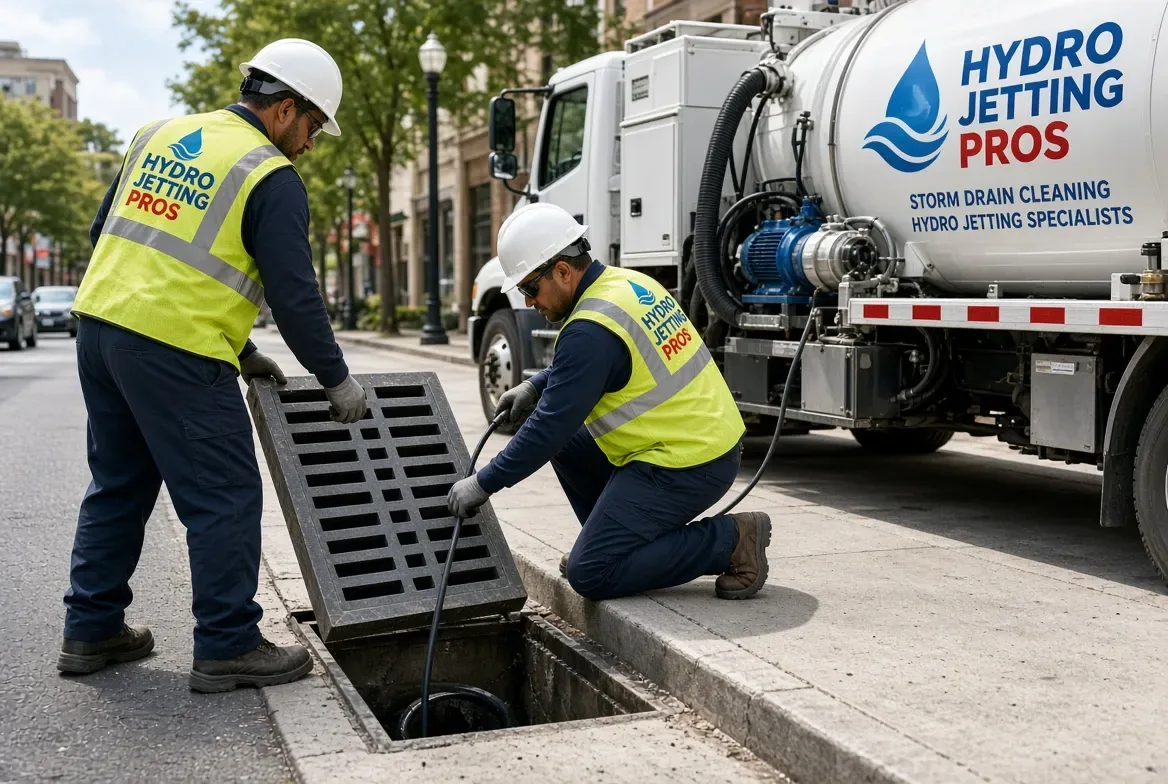
What goes wrong in Florida
Florida storm drainage gets tested on a schedule the whole state knows: hurricane season, June to November. That makes the work unusually easy to plan and unusually expensive to defer. A catch basin or storm line sitting half full of sand has no reserve capacity left when a band of rain actually arrives, and the difference between clearing it in April and clearing it in September is the difference between routine maintenance and an emergency with standing water across a property. Every year we take calls in the middle of a storm that would have been a cheap spring visit.
What fills Florida storm drains is mostly sand, and it arrives continuously rather than only in weather. It washes off sandy ground, car parks and construction around the clock, and in flat-run pipe there is no velocity to carry it onward, so it settles in the bottom of basins and the low points of the system. Leaves and debris are a smaller part of the picture here than in a northern state. A look down a grate tells you very little about any of it — the sand that matters is sitting in the pipe downstream where nobody can see it.
The flat ground is the thing that makes all of it unforgiving. With almost no elevation change, Florida surface water is not really drained away by gravity so much as moved — through retention ponds, outfalls, culverts and pumping — and every one of those assumes the pipe between them is clear. A single silted run is enough to flood a car park that has never flooded in twenty years, and because nothing about the surface changed, the cause is rarely obvious from above. Jetting with vacuum recovery is what empties the line and gets the capacity back.
How storm drain cleaning works in detail — the method, the equipment and what we look for, written for any state.
What makes this a Florida problem
Drain lines fail for local reasons. These are the conditions that drive storm drain cleaning work across Florida.
Hurricane season is a deadline, not a risk
Florida storm drainage has a known annual test from June to November, and the work is far cheaper before it than during it. A catch basin or storm line half full of sand has no capacity left when a band of rain actually arrives. Clearing storm drainage in spring is routine maintenance; clearing it in September is an emergency with standing water on the property.
Sand and silt load like nowhere else
Florida storm drains fill with sand. It washes off sandy ground and parking areas continuously, not just in storms, and it settles in flat-run pipe and basins where there is no velocity to carry it on. Vacuum and jetting together are what empties that; a visual check at the grate tells you almost nothing about how much is sitting in the line downstream.
Flat ground and nowhere for water to go
With almost no elevation change, Florida surface water does not drain away by gravity so much as get moved. Systems depend on retention ponds, outfalls and pumping, and every one of those assumes the pipe between them is clear. A single silted run is enough to flood a car park that has never flooded before, which is the complaint that usually brings us out.
Signs you need this service
Two or more of these together usually means the line is restricted rather than one fixture being blocked.
- Ponding in a car park or yard that drains slowly after rain
- Catch basin grates holding standing water
- Visible silt, gravel or leaf litter filling a basin sump
- Water backing out of an area drain during heavy rain
- Erosion or scouring around a drain inlet
- Storm lines that have never been inspected or cleaned
How we do it
-
Survey the site drainage
Catch basins, area drains, trench drains, outlets and discharge point — including the inlets nobody has looked in for years.
-
Clear sediment from the basin sumps
Removing settled grit at the source stops it migrating into the outlet pipe and silting the run.
-
Jet the outlet and connecting lines
High-volume jetting moves compacted silt and debris that no cable will shift.
-
Camera where the line is suspect
Storm lines crack, separate and get crushed under vehicle loading. Inspection distinguishes a silted pipe from a failed one.
-
Schedule before the wet season
The right time for this work is ahead of the weather, not during the storm that proves the system was blocked.
Who this is for
Commercial property
Car parks, retail sites and business parks where surface water reaches doors and loading docks.
Industrial and logistics
Large hardstanding areas, trench drains and heavy vehicle loading over shallow storm lines.
HOAs and managed sites
Shared roads, common areas and drainage that is nobody's job until it floods.
Storm Drain Cleaning across Florida
We cover 411 Florida cities and towns across 67 counties, from the big metros to towns of a few hundred people.
See the full list of Florida cities we cover, or call (833) 349-0333 and tell us where you are.
Storm Drain Cleaning questions
When should Florida storm drains be cleaned?
Before hurricane season, which in practice means spring. That gives you the system's full capacity going into the months it will actually be tested, and it gets the work done at maintenance prices rather than emergency ones. Properties with a history of ponding, heavy sand load or nearby construction are better on a twice-yearly interval — once before the season and once after, because a big storm leaves a lot of sediment behind it.
Our car park floods but the grates look clear. Why?
Because the problem is almost never at the grate. In Florida it is usually sand and silt accumulated in the pipe run or the catch basin sump downstream, where flat gradients let it settle out of the flow. The inlet looks fine while the line behind it has lost most of its diameter. A camera inspection of the run finds it quickly, and jetting with vacuum recovery restores the capacity without excavating anything.
Is storm drain cleaning different from sewer cleaning?
Yes. Storm systems carry surface water and block with silt, sand, leaves and litter rather than grease and waste. They often need higher water volume to move compacted sediment, and the access points are catch basins rather than cleanouts.
When should this be done?
Ahead of the wet season. The whole point is to have capacity available before the storm, and that is also when scheduling is easiest.
Who is responsible for the storm drains on our site?
Private drainage on private property is normally the owner's responsibility up to the municipal connection. Inlets on the public road are usually the city's. Site plans — or a camera inspection — settle it.
Our car park floods every heavy rain. Is cleaning enough?
Sometimes. If the system is silted, clearing it restores the capacity it was designed for. If the site was under-drained from the start or a line has collapsed, cleaning will not be enough, and an inspection will tell you which situation you are in.
Other services
Sewer Line Cleaning in Florida
Clears the main line that carries waste from your building to the municipal sewer or septic tank.
Service detailsDrain Line Cleaning in Florida
Clears the branch lines running from individual sinks, tubs, showers and floor drains into the main.
Service detailsMain Sewer Line Clog Removal in Florida
Emergency clearing when the main line is fully blocked and waste is backing up into the building.
Service detailsCommercial Drain Cleaning in Florida
Scheduled and emergency drain service for buildings where a backup means closing the doors.
Service detailsGrease Line Cleaning in Florida
Removes hardened fat, oil and grease from kitchen waste lines and interceptor runs.
Service detailsRestaurant Drain Cleaning in Florida
Drain service built around a working kitchen — floor sinks, dish pit, prep lines and interceptor.
Service detailsNeed storm drain cleaning in Florida?
Describe what the drain is doing and we will tell you whether this is an emergency, a cleaning job, or something that needs a camera down the line first.
(833) 349-033324/7 emergency service