Grease line cleaning
Fat, oil and grease go down a kitchen drain as warm liquid and stop being liquid about three metres later. FOG is the single most common reason commercial kitchen lines fail, and it is the clearest case where jetting is the only method that genuinely works.
What goes wrong
Grease coats. It does not sit in the pipe as a plug you can punch through — it adheres to the wall in layers, hardening as it cools and thickening with every service. Over months the pipe's working diameter shrinks from the outside in, evenly, all the way along the run.
This is why cabling a grease line is close to pointless. The cable spins a hole through the middle of a soft, sticky deposit that immediately closes behind it. Flow returns for days or weeks. The deposit is untouched. Enzyme and bacterial treatments help maintain an already-clean line, but they will not remove an established layer.
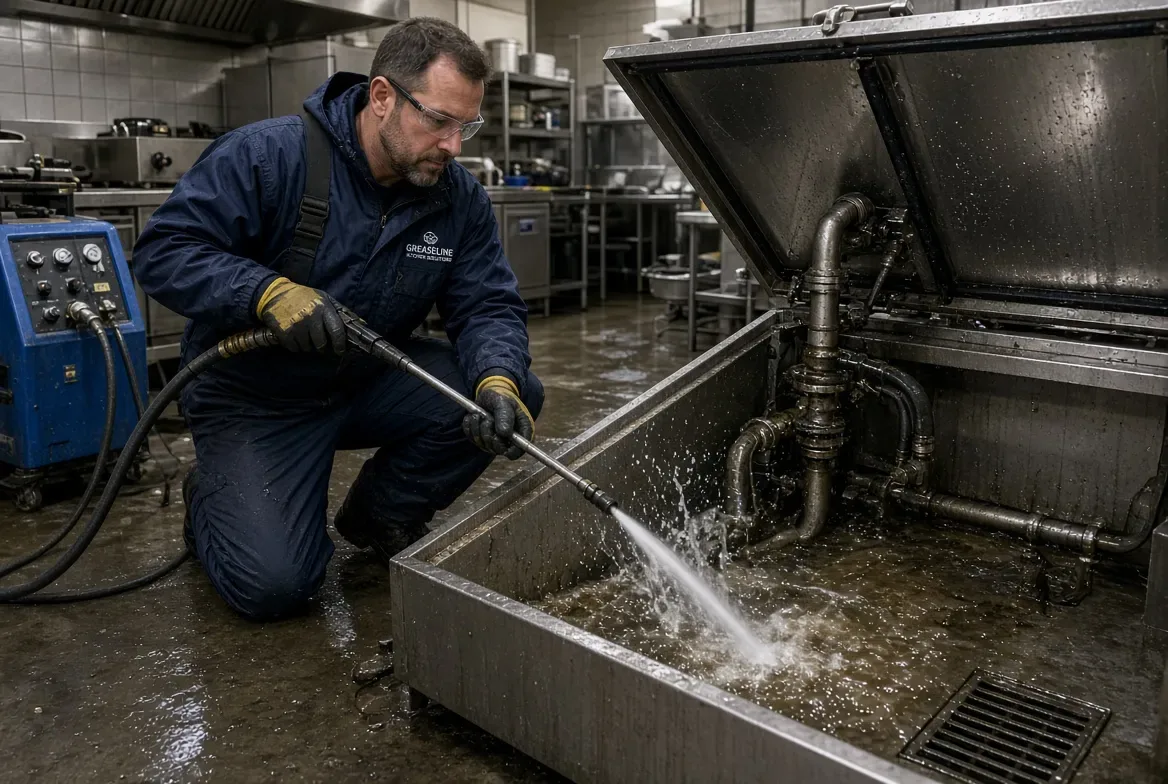
Jetting works because it attacks the wall rather than the centre. A rotating nozzle delivers water across the full circumference, shearing the deposit off the pipe, and hot-water jetting softens hardened FOG so it releases instead of smearing. The material flushes out of the system rather than moving ten feet downstream to block somewhere less convenient.
Signs you need this service
Two or more of these together usually means the line is restricted rather than one fixture being blocked.
- Kitchen drains slowing progressively over weeks rather than suddenly
- Standing water in floor sinks or a dish pit
- Grease interceptor filling faster than it used to
- Rancid smell near kitchen drains or the interceptor
- Backups that return within weeks of being cabled
- Lines that have never been jetted in a kitchen that has run for years
How we do it
-
Inspect the kitchen run and the interceptor
We look at the whole path — floor sinks, dish pit, horizontal run, interceptor inlet and outlet — because grease rarely builds in only one place.
-
Hot-water jet where FOG has hardened
Heat softens set grease so it shears off the wall cleanly instead of smearing along it. This is the difference between removing a deposit and relocating it.
-
Work the full circumference of the pipe
A rotating nozzle cuts the deposit off the entire wall, which is the only way to get the original diameter back.
-
Flush the line out through the interceptor
Loosened grease has to leave the system, not settle in the next low spot.
-
Set a realistic interval
A busy fryer-heavy kitchen is a quarterly job. Lighter food service is often semi-annual. We would rather set this from your actual line than sell you a plan you do not need.
Who this is for
Commercial kitchens
Any operation producing FOG daily — the core case for scheduled jetting rather than reactive callouts.
Food manufacturing
Processing and packing facilities with high-volume fat and oil loads through fixed drainage.
Multi-tenant food halls
Shared waste lines where one tenant's grease becomes every tenant's backup.
Where we do this work
We take grease line cleaning work nationwide. Texas is our first fully mapped state, down to individual city coverage.
Grease Line Cleaning in Texas
Expansive clay soil, aging cast iron and year-round root growth make Texas lines fail faster than the national average. We cover 1,228 Texas cities across 244 counties.
Not in Texas?
Call us anyway. We work nationwide, and more states are being mapped the same way. If we can cover your address we will tell you on the phone, and if we cannot we will say that rather than waste your time.
Grease Line Cleaning questions
Why will cabling not fix a grease line?
A cable bores a hole through the middle of a soft deposit and the deposit closes behind it. The grease is still lining the wall. Jetting shears it off the pipe and flushes it out, which is why the result lasts.
Do enzyme treatments work?
They help maintain a line that is already clean, and they are a reasonable part of a routine. They will not remove an established hardened deposit — that needs mechanical removal.
How often should a commercial kitchen jet its grease line?
A high-volume fryer-heavy kitchen is typically quarterly. Lighter food service is often semi-annual. The right interval comes from inspecting your line, not from a standard package.
Does this replace having the grease interceptor pumped?
No — they are different jobs. Pumping empties the interceptor; jetting cleans the pipe runs feeding and leaving it. A kitchen needs both, and a clean interceptor with a choked inlet line will still back up.
Other services
Sewer Line Cleaning
Clears the main line that carries waste from your building to the municipal sewer or septic tank.
Service detailsDrain Line Cleaning
Clears the branch lines running from individual sinks, tubs, showers and floor drains into the main.
Service detailsMain Sewer Line Clog Removal
Emergency clearing when the main line is fully blocked and waste is backing up into the building.
Service detailsCommercial Drain Cleaning
Scheduled and emergency drain service for buildings where a backup means closing the doors.
Service detailsRestaurant Drain Cleaning
Drain service built around a working kitchen — floor sinks, dish pit, prep lines and interceptor.
Service detailsStorm Drain Cleaning
Clears catch basins, area drains and storm lines so sites drain before the water reaches the building.
Service detailsNeed grease line cleaning?
Describe what the drain is doing and we will tell you whether this is an emergency, a cleaning job, or something that needs a camera down the line first.
(833) 349-033324/7 emergency service