Grease line cleaning in Texas
Texas runs one of the largest food service sectors in the country and most of its cities enforce grease control programmes. Keeping kitchen lines clear here is a compliance matter as much as a plumbing one.
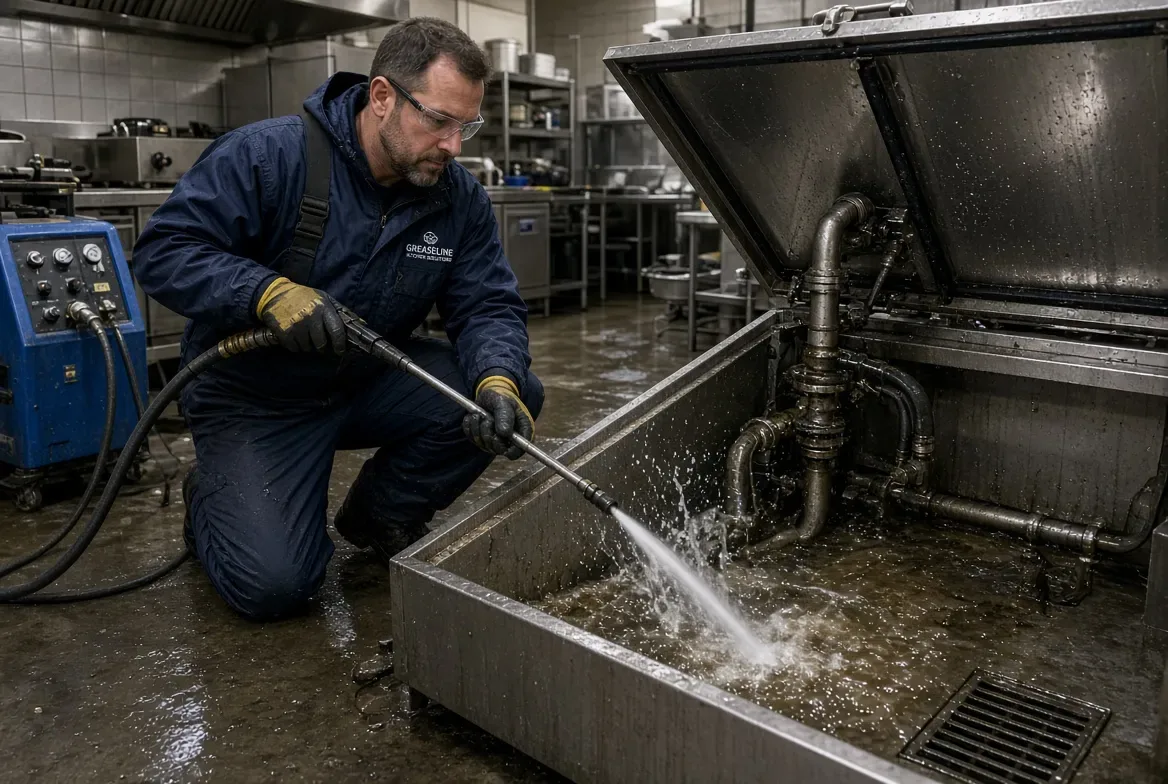
What goes wrong in Texas
Houston, Dallas, San Antonio, Austin and most mid-size Texas municipalities operate grease control programmes covering interceptor sizing, cleaning frequency and record-keeping for food service premises. Enforcement is real, and grease discharged into the public sewer is the operator's problem, not the city's. A choked kitchen line is therefore not only a backup risk — it is a compliance exposure with a paper trail attached.
The scale of the sector is what makes this the most consistent commercial drainage work in the state. Texas food service is concentrated heavily in four metros, with enormous density of fryer-heavy kitchens, and those kitchens share waste lines in strip centres and food halls where one operator's grease becomes everyone's backup.
Texas heat then makes the same deposit behave worse than it would elsewhere. Grease sitting in a warm drain line turns rancid faster and generates hydrogen sulphide sooner. That gas is what staff smell at the dish pit, and it is also what eats the crown of cast iron pipe from the inside. In most Texas kitchens the smell arrives well before the blockage does, which is a useful warning if anyone acts on it.
How grease line cleaning works in detail — the method, the equipment and what we look for, written for any state.
What makes this a Texas problem
Drain lines fail for local reasons. These are the conditions that drive grease line cleaning work across Texas.
Texas cities run active FOG programmes
Houston, Dallas, San Antonio, Austin and most mid-size Texas municipalities operate grease control programmes with interceptor requirements, cleaning intervals and record-keeping obligations for food service. Enforcement is real, and a line or interceptor that discharges grease into the public sewer is the operator's problem. Keeping the run clean is part of staying compliant.
A restaurant industry at enormous scale
Texas has one of the largest food service sectors in the country, concentrated heavily in four metros. That density is why grease line work is the most consistent commercial drainage demand in the state — and why kitchens that treat jetting as scheduled maintenance rather than emergency repair are the ones that stay open.
Warm ground, faster decay, worse smell
Grease deposits in a warm Texas drain line turn rancid and generate hydrogen sulphide faster than they would in a cold climate. That gas is what you smell in a dish pit, and it is also what corrodes the top of cast iron pipe. The smell usually arrives well before the blockage does.
Signs you need this service
Two or more of these together usually means the line is restricted rather than one fixture being blocked.
- Kitchen drains slowing progressively over weeks rather than suddenly
- Standing water in floor sinks or a dish pit
- Grease interceptor filling faster than it used to
- Rancid smell near kitchen drains or the interceptor
- Backups that return within weeks of being cabled
- Lines that have never been jetted in a kitchen that has run for years
How we do it
-
Inspect the kitchen run and the interceptor
We look at the whole path — floor sinks, dish pit, horizontal run, interceptor inlet and outlet — because grease rarely builds in only one place.
-
Hot-water jet where FOG has hardened
Heat softens set grease so it shears off the wall cleanly instead of smearing along it. This is the difference between removing a deposit and relocating it.
-
Work the full circumference of the pipe
A rotating nozzle cuts the deposit off the entire wall, which is the only way to get the original diameter back.
-
Flush the line out through the interceptor
Loosened grease has to leave the system, not settle in the next low spot.
-
Set a realistic interval
A busy fryer-heavy kitchen is a quarterly job. Lighter food service is often semi-annual. We would rather set this from your actual line than sell you a plan you do not need.
Who this is for
Commercial kitchens
Any operation producing FOG daily — the core case for scheduled jetting rather than reactive callouts.
Food manufacturing
Processing and packing facilities with high-volume fat and oil loads through fixed drainage.
Multi-tenant food halls
Shared waste lines where one tenant's grease becomes every tenant's backup.
Grease Line Cleaning across Texas
We cover 1,228 Texas cities and towns across 244 counties, from the four big metros to towns of a few hundred people.
See the full list of Texas cities we cover, or call (833) 349-0333 and tell us where you are.
Grease Line Cleaning questions
Will jetting help us stay compliant with our city's grease programme?
It is part of it. Most Texas municipal programmes require interceptors to be maintained and records kept. Jetting cleans the pipe runs feeding and leaving the interceptor, which pumping does not touch, and we leave documentation of what was found and done so you have it on file.
Is jetting the same as having our grease trap pumped?
No, and a kitchen needs both. Pumping empties the interceptor. Jetting cleans the lines running into and out of it. A freshly pumped interceptor with a grease-choked inlet line will still back up into your kitchen, which is a call we take in Texas more often than you would think.
Why will cabling not fix a grease line?
A cable bores a hole through the middle of a soft deposit and the deposit closes behind it. The grease is still lining the wall. Jetting shears it off the pipe and flushes it out, which is why the result lasts.
Do enzyme treatments work?
They help maintain a line that is already clean, and they are a reasonable part of a routine. They will not remove an established hardened deposit — that needs mechanical removal.
How often should a commercial kitchen jet its grease line?
A high-volume fryer-heavy kitchen is typically quarterly. Lighter food service is often semi-annual. The right interval comes from inspecting your line, not from a standard package.
Does this replace having the grease interceptor pumped?
No — they are different jobs. Pumping empties the interceptor; jetting cleans the pipe runs feeding and leaving it. A kitchen needs both, and a clean interceptor with a choked inlet line will still back up.
Other services
Sewer Line Cleaning in Texas
Clears the main line that carries waste from your building to the municipal sewer or septic tank.
Service detailsDrain Line Cleaning in Texas
Clears the branch lines running from individual sinks, tubs, showers and floor drains into the main.
Service detailsMain Sewer Line Clog Removal in Texas
Emergency clearing when the main line is fully blocked and waste is backing up into the building.
Service detailsCommercial Drain Cleaning in Texas
Scheduled and emergency drain service for buildings where a backup means closing the doors.
Service detailsRestaurant Drain Cleaning in Texas
Drain service built around a working kitchen — floor sinks, dish pit, prep lines and interceptor.
Service detailsStorm Drain Cleaning in Texas
Clears catch basins, area drains and storm lines so sites drain before the water reaches the building.
Service detailsNeed grease line cleaning in Texas?
Describe what the drain is doing and we will tell you whether this is an emergency, a cleaning job, or something that needs a camera down the line first.
(833) 349-033324/7 emergency service