Main sewer line clog removal in Texas
In Texas the main usually blocks for one of three reasons: the clay moved, the roots arrived, or the storm was bigger than the municipal system.
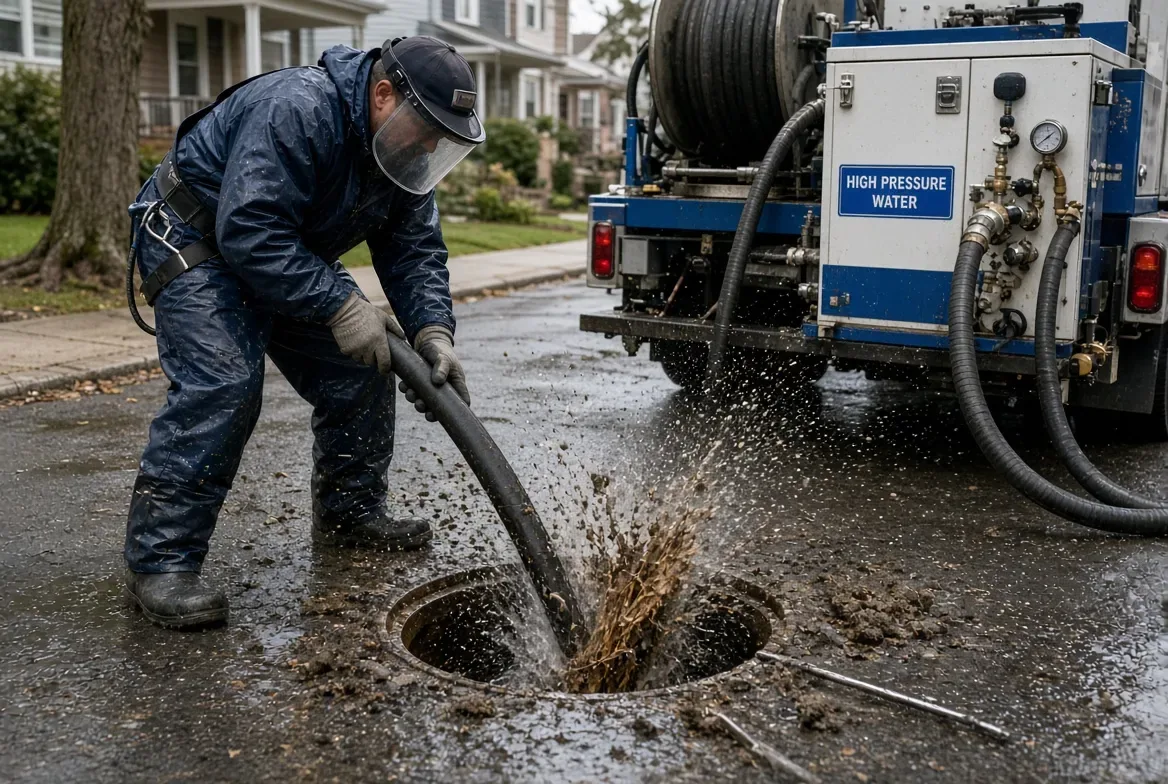
What goes wrong in Texas
A Texas main rarely blocks out of nowhere. It has normally been restricting for months while clay soil worked a joint apart and roots thickened inside it. What makes the failure sudden is the weather. Through a long dry spell the clay shrinks away from the pipe and pulls those joints further open; when the rain finally comes it drives groundwater and silt straight through the gaps. A line that coped for years can block completely in the week the weather turns.
There is a second Texas failure mode that catches people out, and it is not your pipe's fault at all. In extreme rainfall — most often along the Gulf Coast and through Houston — municipal sewers can surcharge. When the public main is full, your private lateral has nowhere to discharge, and waste comes back up through the lowest opening in the building even though your line is perfectly clear. Clearing a line in that situation achieves nothing until the public system drops.
Either way the first move is the same, and you can do it before anyone arrives: stop running water anywhere in the building. No toilets, no laundry, no dishwasher. Every litre you add has to come out somewhere, and right now that is your floor.
How main sewer line clog removal works in detail — the method, the equipment and what we look for, written for any state.
What makes this a Texas problem
Drain lines fail for local reasons. These are the conditions that drive main sewer line clog removal work across Texas.
Drought then downpour is the worst case
Texas swings between long dry spells and heavy rain. Clay shrinks away from pipes in drought, pulling joints apart, and then a heavy storm drives groundwater and silt through those openings. A main that had been coping for years can block completely in the week the weather turns.
Storm events overload municipal systems
Along the Gulf Coast and through Houston in particular, extreme rainfall can surcharge municipal sewers. When the public main is full, a private line has nowhere to discharge and backs up into the lowest fixture in the building — even when the private line itself is perfectly clear.
Older unincorporated areas and septic transitions
Plenty of Texas property sits on lines installed before the area was annexed, or on a septic system converted to municipal sewer at some point. Those transitions tend to leave undersized runs, abandoned sections and odd joints that collect solids and block without much warning.
Signs you need this service
Two or more of these together usually means the line is restricted rather than one fixture being blocked.
- Sewage coming up at a floor drain, tub or shower
- Every toilet in the building is out of service at once
- Water rising in a toilet bowl when the kitchen sink runs
- Sewage visible at an outdoor cleanout, or the cap pushed off
- Loud gurgling from several fixtures with nothing draining
- Standing water or smell around the line's path through the yard
How we do it
-
Stop the backup
First call: stop running water anywhere in the building. We will tell you this on the phone, because it limits the damage before anyone arrives.
-
Open the line from the cleanout
We relieve the blockage from the nearest downstream access so waste drains away from the building rather than further into it.
-
Clear the full diameter, not just a channel
Once flow is back, jetting removes what caused the restriction in the first place. Stopping at a channel through the middle is what produces a repeat call a few weeks later.
-
Camera the line and find the cause
Roots, grease, scale, a belly, an offset joint or a break — each means a different next step. You get to see the footage.
-
Tell you plainly what comes next
Sometimes the answer is cleaning on a schedule. Sometimes it is a repair, and we will say so even though cleaning is what we sell.
Who this is for
Homeowners mid-backup
The urgent case: waste in the house, and the priority is getting it stopped and the line open.
Landlords and managers
A blocked main in a multi-unit building is an immediate habitability problem across every unit.
Businesses that cannot close
Restaurants, clinics and retail where a blocked main means shutting the doors.
Main Sewer Line Clog Removal across Texas
We cover 1,228 Texas cities and towns across 244 counties, from the four big metros to towns of a few hundred people.
See the full list of Texas cities we cover, or call (833) 349-0333 and tell us where you are.
Main Sewer Line Clog Removal questions
Sewage came up during a storm but my drains seem fine now. What happened?
That is the classic Texas surcharge pattern, particularly on the Gulf Coast and in Houston. When extreme rainfall fills the municipal sewer, your lateral cannot discharge and backs up through the lowest fixture even though your own line is clear. It is still worth a camera inspection, because a line that has taken a surcharge often has silt driven into it.
Who pays for the repair in Texas, me or the city?
The split is normally at the property line or the municipal tap, with the lateral on your side being the property owner's responsibility. It varies by municipality. A camera inspection locates the blockage and gives you footage with distance from the access point, which is exactly what you need if it turns out to be on the public side.
My sewage is backing up right now. What do I do first?
Stop using water anywhere in the building — no toilets, taps, laundry or dishwasher. Every litre you add has to come out somewhere, and right now that is your floor. Then call us on (833) 349-0333.
Is a main line clog ever a DIY job?
Occasionally a cleanout is accessible and the obstruction is close and soft. Mostly it is not, and the two common DIY outcomes are a cable jammed in the line and a pressurised backup into the building. Sewage is also a biohazard and needs cleaning up properly.
Who pays — me or the city?
The split is usually at the property line or the municipal tap, with the lateral on your side being yours. It varies by municipality. A camera inspection locates the problem and gives you the footage, which is what you need if the blockage turns out to be on the public side.
Will clearing the clog stop it happening again?
Only if the cause is gone. That is why we camera the line after opening it. If the footage shows a root mass at a cracked joint or a section holding water, cleaning alone is a temporary fix and you deserve to know that.
Other services
Sewer Line Cleaning in Texas
Clears the main line that carries waste from your building to the municipal sewer or septic tank.
Service detailsDrain Line Cleaning in Texas
Clears the branch lines running from individual sinks, tubs, showers and floor drains into the main.
Service detailsCommercial Drain Cleaning in Texas
Scheduled and emergency drain service for buildings where a backup means closing the doors.
Service detailsGrease Line Cleaning in Texas
Removes hardened fat, oil and grease from kitchen waste lines and interceptor runs.
Service detailsRestaurant Drain Cleaning in Texas
Drain service built around a working kitchen — floor sinks, dish pit, prep lines and interceptor.
Service detailsStorm Drain Cleaning in Texas
Clears catch basins, area drains and storm lines so sites drain before the water reaches the building.
Service detailsNeed main sewer line clog removal in Texas?
Describe what the drain is doing and we will tell you whether this is an emergency, a cleaning job, or something that needs a camera down the line first.
(833) 349-033324/7 emergency service