Grease line cleaning in Florida
Florida's kitchen density, enforced FOG rules and year-round warm pipe make grease line work both the most common commercial job in the state and the most expensive one to neglect.
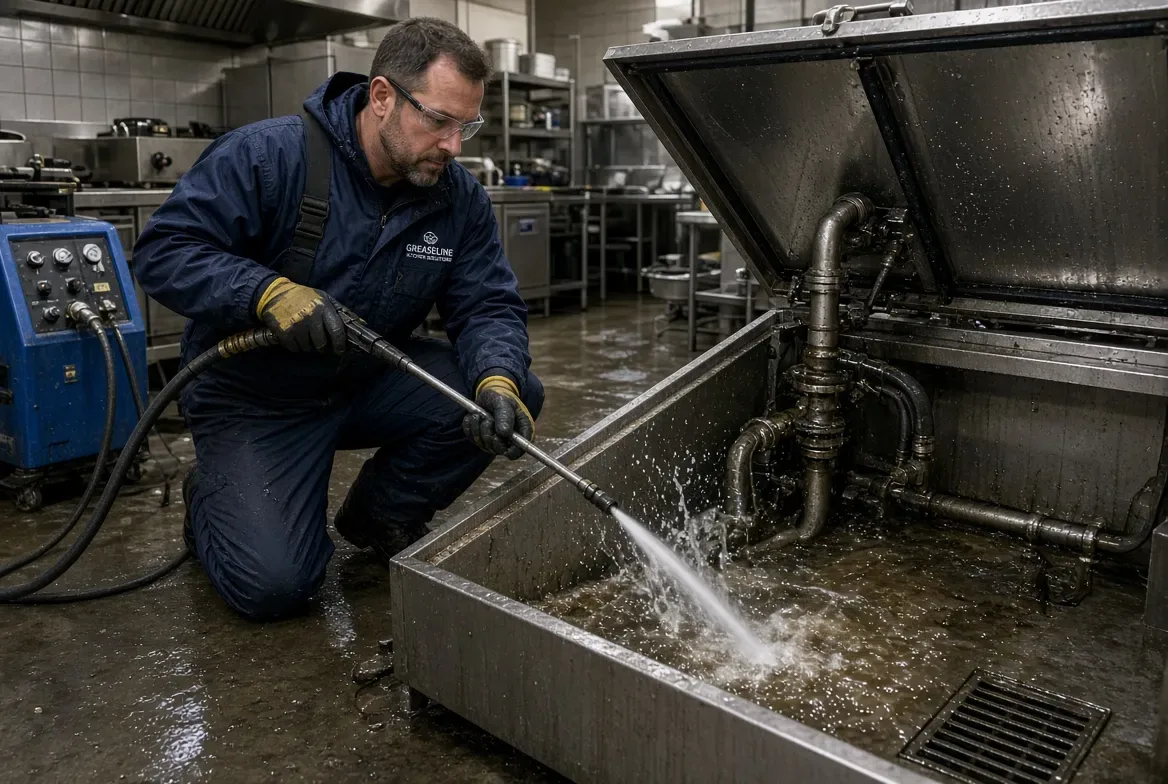
What goes wrong in Florida
Florida supports an enormous number of commercial kitchens for its population, because the tourism economy puts restaurants everywhere people visit — the coasts, the Keys, the Orlando corridor and every resort area in between. That density is why grease is the defining commercial drainage problem here. A kitchen line coats from the inside with a hardening layer of fats, oils and food solids until the bore is a fraction of its diameter, and a degreaser poured down a drain does not remove that layer, it just moves a little of it further along the pipe.
The compliance side has real teeth. Miami-Dade, Broward, Orlando, Tampa, Jacksonville and most mid-size Florida municipalities operate fats, oils and grease programmes with interceptor sizing requirements, mandated cleaning frequencies and manifest records. Jetting the line on an interval and keeping the documentation is the straightforward half of staying compliant — inspectors ask for the paperwork about as readily as they look inside the interceptor, and a venue that cannot produce it has a problem regardless of how clean the line is.
The climate then accelerates everything. Grease in a Florida drain line never gets a cold spell to sit inert through: it stays soft enough to keep migrating and coating, and it turns rancid and produces hydrogen sulphide quickly in warm, humid pipe. That gas is the smell staff report before flow actually slows, which makes it the most useful early warning a kitchen gets — and it is also what corrodes cast iron from the inside, so an ignored grease line damages the pipe as well as blocking it.
How grease line cleaning works in detail — the method, the equipment and what we look for, written for any state.
What makes this a Florida problem
Drain lines fail for local reasons. These are the conditions that drive grease line cleaning work across Florida.
FOG programmes with real enforcement
Miami-Dade, Broward, Orlando, Tampa, Jacksonville and most mid-size Florida municipalities run fats, oils and grease programmes with interceptor sizing rules, cleaning frequencies and manifest records. Jetting the line and keeping documentation of it is the practical half of staying compliant, and inspectors ask for the paperwork as readily as they look at the interceptor.
One of the densest restaurant markets anywhere
Florida's tourism economy supports an enormous number of commercial kitchens relative to its population, concentrated hard along the coasts and the Orlando corridor. That density is why grease work is the highest-value recurring service in the state — and why a kitchen that loses its drains in season loses real money per hour, not per day.
Warm ground makes grease worse, faster
Grease in a Florida drain line never gets a cold spell to stay inert through. It stays soft enough to keep moving down the line and coating it, then turns rancid and generates hydrogen sulphide quickly in warm, humid pipe. That gas is the smell staff complain about before the line actually blocks, and it is also what corrodes cast iron from the inside.
Signs you need this service
Two or more of these together usually means the line is restricted rather than one fixture being blocked.
- Kitchen drains slowing progressively over weeks rather than suddenly
- Standing water in floor sinks or a dish pit
- Grease interceptor filling faster than it used to
- Rancid smell near kitchen drains or the interceptor
- Backups that return within weeks of being cabled
- Lines that have never been jetted in a kitchen that has run for years
How we do it
-
Inspect the kitchen run and the interceptor
We look at the whole path — floor sinks, dish pit, horizontal run, interceptor inlet and outlet — because grease rarely builds in only one place.
-
Hot-water jet where FOG has hardened
Heat softens set grease so it shears off the wall cleanly instead of smearing along it. This is the difference between removing a deposit and relocating it.
-
Work the full circumference of the pipe
A rotating nozzle cuts the deposit off the entire wall, which is the only way to get the original diameter back.
-
Flush the line out through the interceptor
Loosened grease has to leave the system, not settle in the next low spot.
-
Set a realistic interval
A busy fryer-heavy kitchen is a quarterly job. Lighter food service is often semi-annual. We would rather set this from your actual line than sell you a plan you do not need.
Who this is for
Commercial kitchens
Any operation producing FOG daily — the core case for scheduled jetting rather than reactive callouts.
Food manufacturing
Processing and packing facilities with high-volume fat and oil loads through fixed drainage.
Multi-tenant food halls
Shared waste lines where one tenant's grease becomes every tenant's backup.
Grease Line Cleaning across Florida
We cover 411 Florida cities and towns across 67 counties, from the big metros to towns of a few hundred people.
See the full list of Florida cities we cover, or call (833) 349-0333 and tell us where you are.
Grease Line Cleaning questions
How often should a Florida restaurant jet its grease line?
Quarterly is the common interval for a busy kitchen, and high-volume operations often need it more frequently than that. Your municipality may set a minimum frequency for interceptor servicing, which is the floor rather than the answer — the line itself needs cleaning on its own schedule. The honest way to set it is to jet the line, look at the rate it coats back up, and settle on an interval from that rather than from a generic figure.
Is jetting better than enzymes or degreasers for grease?
For the line, yes, and by a wide margin. Enzyme and chemical treatments work on the thin surface layer and are reasonable for maintenance between cleanings, but they do not remove an established deposit — they soften a little of it and send it downstream, where it hardens again somewhere less convenient. Hot-water jetting cuts the deposit off the pipe wall and flushes it out of the system. On a Florida kitchen line running warm year-round, that difference shows up fast.
Why will cabling not fix a grease line?
A cable bores a hole through the middle of a soft deposit and the deposit closes behind it. The grease is still lining the wall. Jetting shears it off the pipe and flushes it out, which is why the result lasts.
Do enzyme treatments work?
They help maintain a line that is already clean, and they are a reasonable part of a routine. They will not remove an established hardened deposit — that needs mechanical removal.
How often should a commercial kitchen jet its grease line?
A high-volume fryer-heavy kitchen is typically quarterly. Lighter food service is often semi-annual. The right interval comes from inspecting your line, not from a standard package.
Does this replace having the grease interceptor pumped?
No — they are different jobs. Pumping empties the interceptor; jetting cleans the pipe runs feeding and leaving it. A kitchen needs both, and a clean interceptor with a choked inlet line will still back up.
Other services
Sewer Line Cleaning in Florida
Clears the main line that carries waste from your building to the municipal sewer or septic tank.
Service detailsDrain Line Cleaning in Florida
Clears the branch lines running from individual sinks, tubs, showers and floor drains into the main.
Service detailsMain Sewer Line Clog Removal in Florida
Emergency clearing when the main line is fully blocked and waste is backing up into the building.
Service detailsCommercial Drain Cleaning in Florida
Scheduled and emergency drain service for buildings where a backup means closing the doors.
Service detailsRestaurant Drain Cleaning in Florida
Drain service built around a working kitchen — floor sinks, dish pit, prep lines and interceptor.
Service detailsStorm Drain Cleaning in Florida
Clears catch basins, area drains and storm lines so sites drain before the water reaches the building.
Service detailsNeed grease line cleaning in Florida?
Describe what the drain is doing and we will tell you whether this is an emergency, a cleaning job, or something that needs a camera down the line first.
(833) 349-033324/7 emergency service