Sewer line cleaning in Florida
Florida sewer lines fail on sand, flat ground and sixty-year-old cast iron — a completely different set of causes from most of the country, and they need a different method.
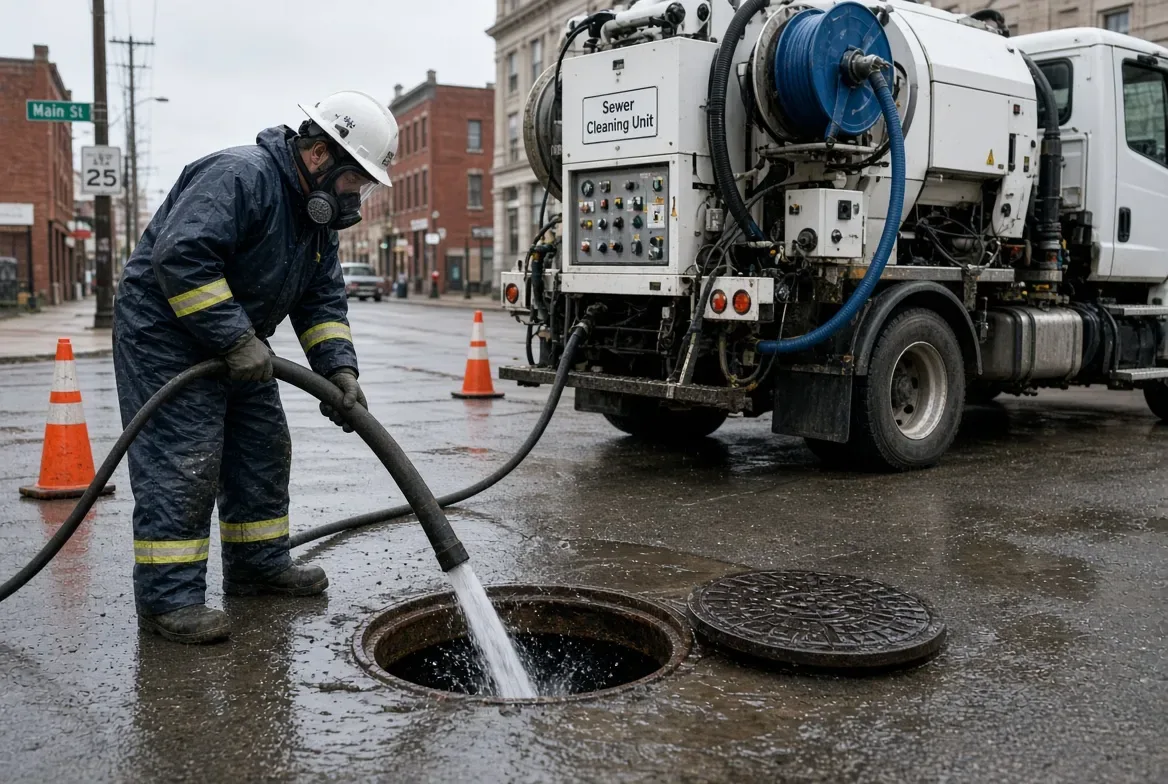
What goes wrong in Florida
The first thing to understand about a Florida sewer line is that the soil comes into the pipe. In a clay state the ground moves the pipe around from outside; here, fine sand travels in with groundwater through any crack, open joint or failed seal. And because Florida is flat, that sand does not wash through to the main — it drops out in the first low spot and compacts into a dense bar. This is the single most common thing we find in a Florida line, and it is also the one most often cleared badly: a cable bores a hole through the middle of a sand bar and leaves the rest of it sitting in the pipe.
Then there is the pipe itself. Florida's growth decades ran from the 1950s to the mid-1970s, and the drainage that went in then was overwhelmingly cast iron, with Orangeburg fibre pipe in a lot of subdivisions. Cast iron scales inward until the bore is a fraction of what it was, and the humidity and high water table here never gave it the dry spells that would have slowed that down. Jetting takes the scale off the wall. The camera pass afterwards is what tells you whether there is sound pipe behind it — and on Orangeburg, the camera comes first, because that material will not survive full pressure.
The third factor is slope, and it is the one homeowners are never told about. Florida has no topography to work with, so laterals are laid at the minimum fall that will pass inspection and occasionally less than that. A line with good fall scours itself every time a toilet flushes; a Florida line at marginal fall does not, and once a section settles into a belly it holds standing water for good. That is why we camera every line we clean here. It is the difference between a line that needs a maintenance interval and a line that needs repairing, and no amount of cleaning changes which one you have.
How sewer line cleaning works in detail — the method, the equipment and what we look for, written for any state.
What makes this a Florida problem
Drain lines fail for local reasons. These are the conditions that drive sewer line cleaning work across Florida.
Sand infiltration, not soil movement
The defining Florida sewer problem. Groundwater carries fine sand in through cracks and open joints, and on flat ground it settles and compacts in the first low spot rather than washing through. A cable augers a hole in it and leaves the rest. Water is what actually evacuates a sand-loaded line, which is why jetting is not an upgrade here so much as the only method that finishes the job.
Cast iron at or past its service life
Most Florida sewer lateral material from the state's big growth decades is cast iron, and permanent humidity plus a high water table gave it a harder life than the same pipe would have had in a dry climate. It scales inward until the bore is a fraction of its original width. Jetting restores the diameter; the camera afterwards is what tells you whether the wall behind the scale is sound.
Minimal fall and bellied sections
Flat terrain means Florida laterals are laid at the shallowest slope that will pass, so they do not self-scour, and any settlement produces a belly that holds water permanently. A bellied line will keep re-blocking however well it is cleaned, so the camera pass matters as much as the cleaning: it separates lines that need a maintenance interval from lines that need repair.
Signs you need this service
Two or more of these together usually means the line is restricted rather than one fixture being blocked.
- More than one fixture backing up at the same time
- Gurgling from a toilet or tub when a washing machine drains
- Sewage appearing at a floor drain or cleanout — the lowest opening in the system
- Drains that were cabled a few months ago and are slowing again
- Smell of sewer gas near a cleanout or in a basement
- Lawn that is unusually lush or soggy along the line's run
How we do it
-
Locate the cleanout and confirm the blockage
We start at a cleanout rather than pulling a toilet where possible. If there is no accessible cleanout we will tell you before any work starts, because that changes the job.
-
Camera the line first where access allows
Inspecting first tells us what we are dealing with — roots, grease, scale, a belly holding water, or a break. Jetting a collapsed or badly offset pipe will not fix it, and you should know that before you pay for cleaning.
-
Match pressure and nozzle to the pipe
A 6-inch clay main with root intrusion needs a different nozzle and a different approach than a 4-inch PVC line glazed with grease. Old, thin cast iron and Orangeburg need pressure dialled back deliberately.
-
Jet the full run, then flush
We work the nozzle through the entire length to the municipal connection, not just past the blockage, and flush the loosened material out.
-
Re-camera and show you the result
A second pass with the camera is the only honest proof the line is clear. If the inspection shows a structural problem, you get the footage and a straight explanation of the repair options.
Who this is for
Homeowners
A single main line serving the whole house, usually 4 inches, often with root intrusion at clay or cast iron joints.
Property managers
Multi-unit buildings where one restricted main affects every tenant and an overflow becomes a habitability issue.
Commercial buildings
Longer runs, more fixtures, and far less tolerance for closing the building to deal with a backup.
Sewer Line Cleaning across Florida
We cover 411 Florida cities and towns across 67 counties, from the big metros to towns of a few hundred people.
See the full list of Florida cities we cover, or call (833) 349-0333 and tell us where you are.
Sewer Line Cleaning questions
How often do Florida sewer lines need cleaning?
More often than the national average, and the interval is usually set by the pipe's slope rather than by the household. A line with marginal fall or a bellied section is commonly on a yearly schedule because it cannot scour itself between visits. A line with active ficus or banyan roots in South Florida can need it more often than that, because those roots have no dormant season. A well-laid PVC line with proper fall and no root pressure may never need it again — the camera inspection is what tells you which of those you own.
Will jetting damage old Florida pipe?
Not if the pipe is inspected first, which is why we do that as standard on anything built before about 1975. Sound cast iron jets well at a pressure matched to its condition. Orangeburg fibre pipe does not — it has already deformed and full pressure can finish it, so if the camera finds Orangeburg we will tell you the line needs replacing rather than cleaning. Being straight about that is cheaper for you than finding out with a jetter running.
How is hydro jetting different from snaking my sewer line?
A cable cuts a channel through the blockage; jetting scours the pipe wall back to its original diameter. Cabling gets flow back fastest in an emergency, which is sometimes exactly what you need. Jetting is what keeps the line clear, because it removes the material a cable leaves behind.
Can hydro jetting damage my pipes?
It can, if pressure and nozzle are wrong for the pipe. Thin, heavily scaled cast iron, old Orangeburg and already-cracked clay need pressure dialled back or a different approach entirely. That is the reason we camera the line before jetting rather than after.
How often does a sewer line need jetting?
It depends entirely on why it clogs. A line with active root intrusion may need annual service; a restaurant main carrying grease may need quarterly. A clean PVC line with no root pressure may never need it again. The camera inspection is what tells you which one you have.
Do you need a cleanout to jet the line?
An accessible cleanout makes the job faster, safer for the pipe and cheaper. Where there is not one, access may mean pulling a toilet or going through a roof vent, and sometimes installing a cleanout is the sensible first step. We will tell you which applies before starting.
Other services
Drain Line Cleaning in Florida
Clears the branch lines running from individual sinks, tubs, showers and floor drains into the main.
Service detailsMain Sewer Line Clog Removal in Florida
Emergency clearing when the main line is fully blocked and waste is backing up into the building.
Service detailsCommercial Drain Cleaning in Florida
Scheduled and emergency drain service for buildings where a backup means closing the doors.
Service detailsGrease Line Cleaning in Florida
Removes hardened fat, oil and grease from kitchen waste lines and interceptor runs.
Service detailsRestaurant Drain Cleaning in Florida
Drain service built around a working kitchen — floor sinks, dish pit, prep lines and interceptor.
Service detailsStorm Drain Cleaning in Florida
Clears catch basins, area drains and storm lines so sites drain before the water reaches the building.
Service detailsNeed sewer line cleaning in Florida?
Describe what the drain is doing and we will tell you whether this is an emergency, a cleaning job, or something that needs a camera down the line first.
(833) 349-033324/7 emergency service