Hydro jetting in Florida
Sewer and drain cleaning across 411 Florida cities and towns in all 67 counties. Florida lines block for reasons you will not find in a national plumbing guide — sand, flat ground and cast iron that the humidity finished early.
Florida cast iron scales inward while infiltrated sand settles in the bottom. Jetting is what moves sand; a cable will not.
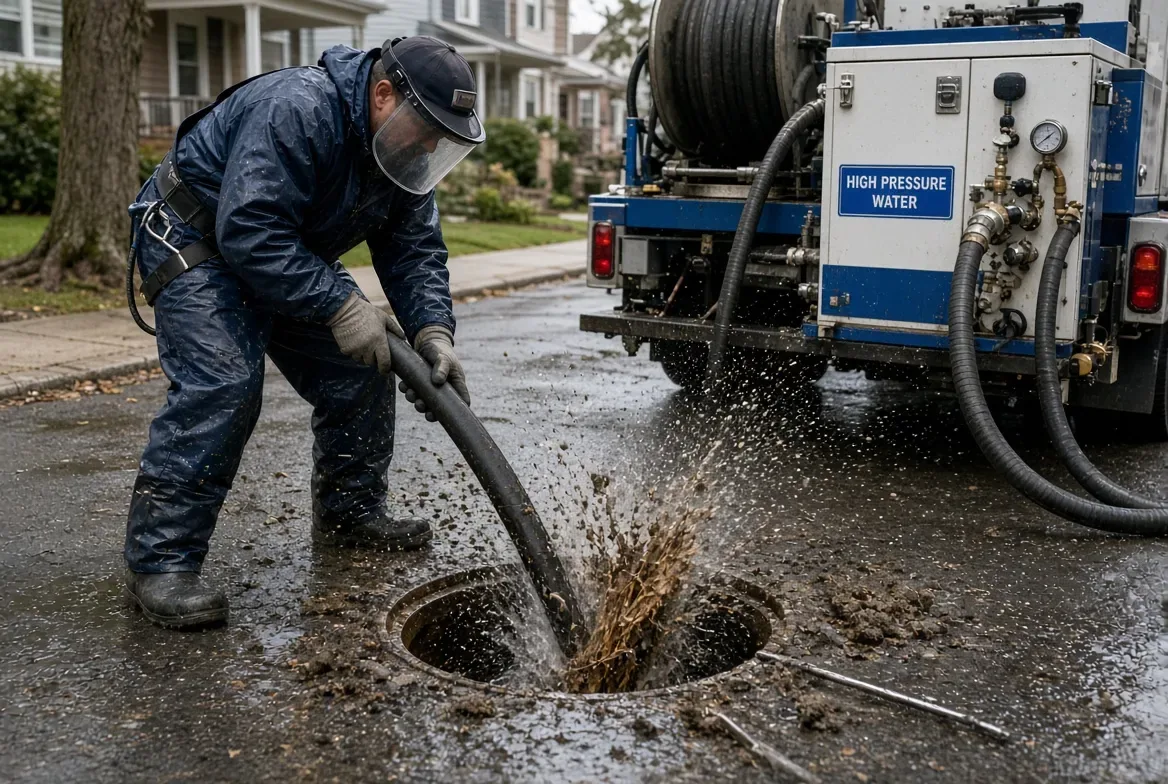
Why Florida drain lines fail faster
These are not generic plumbing problems, and they are not the Texas ones either. They are consequences of Florida sand, a shallow water table, flat ground and a housing stock largely built before 1975.
Cast iron that humidity finished early
Florida's building boom ran from the 1950s to the mid-1970s, and most of it was plumbed in cast iron. Cast iron scales and corrodes from the inside, and in permanent humidity with a water table often at pipe depth it does not get the dry spells that slow that process down. Inner Miami, Fort Lauderdale, St. Petersburg, central Tampa, Orlando and urban Jacksonville are full of pipe at or past the end of its service life. Jetting takes the scale back off the wall; the camera pass is what tells you honestly whether there is sound pipe left underneath.
Sand that migrates into the pipe
This is the Florida blockage. Texas clay moves the pipe from outside; Florida sand comes in through it. Any crack, open joint or failed seal lets fine sand enter with groundwater, and because the ground is flat the sand drops out and stays in the first low spot it reaches. It compacts into a dense bar that a cable will auger a hole through and leave behind. High-pressure water is the only thing that actually evacuates sand from a line.
Flat ground, so nothing self-scours
Florida has almost no topography, which means laterals run at the minimum slope code allows and sometimes less. A line with proper fall scours itself every time a toilet flushes. A Florida line at marginal fall does not: solids, grease and paper settle instead of moving, and once a section bellies it holds standing water permanently. That is why cleaning intervals here are driven by the pipe's slope far more than by how carefully the household uses it.
Roots that genuinely never stop
South Florida sits in USDA zones 10 and 11, where there is no winter dormancy at all — not a short one, none. Ficus and banyan are the worst offenders in the country for sewer damage: the root mass is enormous, it is actively seeking water, and it will widen a hairline joint into a structural failure. Melaleuca, Brazilian pepper and palm root mats do the same at smaller scale. A line cleared of roots in Fort Lauderdale is growing again immediately, not next spring.
A water table at pipe depth
Across coastal Florida and most of the south of the state, groundwater sits within a few feet of the surface, which is the same depth as the sewer lateral. A line in Texas that cracks leaks sewage out. A line in Florida that cracks takes groundwater in, continuously, along with sand. That infiltration is why Florida utilities spend so heavily on inflow and infiltration programmes, and why a camera inspection here often shows water running in at a joint rather than out of one.
Orangeburg pipe from the post-war boom
Bituminous fibre pipe — Orangeburg — was installed widely in Florida subdivisions between roughly 1945 and 1972. It is tar paper, essentially, and it deforms into an oval and then delaminates and collapses. It matters here for one practical reason: **Orangeburg cannot take full jetting pressure.** Identifying it on camera before anyone turns a jetter on is the difference between cleaning a line and destroying it, and it is the main reason we camera first in older Florida neighbourhoods.
Florida services
The same seven services, written for what actually happens to pipe in this state rather than reworded national copy.
Sewer Line Cleaning in Florida
Clears the main line that carries waste from your building to the municipal sewer or septic tank.
Service detailsDrain Line Cleaning in Florida
Clears the branch lines running from individual sinks, tubs, showers and floor drains into the main.
Service detailsMain Sewer Line Clog Removal in Florida
Emergency clearing when the main line is fully blocked and waste is backing up into the building.
Service detailsCommercial Drain Cleaning in Florida
Scheduled and emergency drain service for buildings where a backup means closing the doors.
Service detailsGrease Line Cleaning in Florida
Removes hardened fat, oil and grease from kitchen waste lines and interceptor runs.
Service detailsRestaurant Drain Cleaning in Florida
Drain service built around a working kitchen — floor sinks, dish pit, prep lines and interceptor.
Service detailsStorm Drain Cleaning in Florida
Clears catch basins, area drains and storm lines so sites drain before the water reaches the building.
Service detailsFlorida metros
Florida's demand is spread across more separate metros than most states, and each one fails in its own way.
Largest cities we cover
Population and primary ZIP for the biggest 30 Florida markets.
| City | County | Population | Primary ZIP |
|---|---|---|---|
| Jacksonville | Duval County | 1,009,833 | 32218 |
| Miami | Miami-Dade County | 487,014 | 33142 |
| Tampa | Hillsborough County | 414,547 | 33647 |
| Orlando | Orange County | 334,854 | 32822 |
| St. Petersburg | Pinellas County | 267,102 | 33710 |
| Port St. Lucie | St. Lucie County | 258,575 | 34953 |
| Hialeah | Miami-Dade County | 235,388 | 33012 |
| Cape Coral | Lee County | 233,025 | 33914 |
| Tallahassee | Leon County | 205,089 | 32304 |
| Fort Lauderdale | Broward County | 190,641 | 33311 |
| Pembroke Pines | Broward County | 179,326 | 33028 |
| Hollywood | Broward County | 159,073 | 33024 |
| Gainesville | Alachua County | 148,720 | 32608 |
| Miramar | Broward County | 143,242 | 33025 |
| Palm Bay | Brevard County | 142,023 | 32907 |
| Coral Springs | Broward County | 140,808 | 33065 |
| West Palm Beach | Palm Beach County | 127,744 | 33411 |
| Lakeland | Polk County | 124,990 | 33813 |
| Pompano Beach | Broward County | 118,104 | 33064 |
| Clearwater | Pinellas County | 116,811 | 33756 |
| Miami Gardens | Miami-Dade County | 116,173 | 33056 |
| Davie | Broward County | 112,052 | 33324 |
| Palm Coast | Flagler County | 106,729 | 32164 |
| Boca Raton | Palm Beach County | 102,238 | 33433 |
| Plantation | Broward County | 100,694 | 33313 |
| Deltona | Volusia County | 100,513 | 32725 |
| Sunrise | Broward County | 100,128 | 33313 |
| Fort Myers | Lee County | 99,918 | 33905 |
| North Port | Sarasota County | 92,875 | 34287 |
| Deerfield Beach | Broward County | 90,507 | 33442 |
Every Florida city we cover
All 411 incorporated cities, towns and villages in Florida, from Jacksonville to towns of a few dozen people. Where two Florida places share a name, the county is shown.
A (15)
B (32)
- Bal Harbour
- Baldwin
- Bartow
- Bascom
- Bay Harbor Islands
- Bay Lake
- Bell
- Belle Glade
- Belle Isle
- Belleair
- Belleair Beach
- Belleair Bluffs
- Belleair Shore
- Belleview
- Beverly Beach
- Biscayne Park
- Blountstown
- Boca Raton
- Bonifay
- Bonita Springs
- Bowling Green
- Boynton Beach
- Bradenton
- Bradenton Beach
- Branford
- Briny Breezes
- Bristol
- Bronson
- Brooker
- Brooksville
- Bunnell
- Bushnell
C (32)
- Callahan
- Callaway
- Campbellton
- Cape Canaveral
- Cape Coral
- Carrabelle
- Caryville
- Casselberry
- Cedar Key
- Center Hill
- Century
- Chattahoochee
- Chiefland
- Chipley
- Cinco Bayou
- Clearwater
- Clermont
- Clewiston
- Cloud Lake
- Cocoa
- Cocoa Beach
- Coconut Creek
- Coleman
- Cooper City
- Coral Gables
- Coral Springs
- Cottondale
- Crescent City
- Crestview
- Cross City
- Crystal River
- Cutler Bay
D (17)
F (15)
G (18)
H (21)
I (11)
J (10)
L (33)
- La Crosse
- LaBelle
- Lady Lake
- Lake Alfred
- Lake Buena Vista
- Lake Butler
- Lake City
- Lake Clarke Shores
- Lake Hamilton
- Lake Helen
- Lake Mary
- Lake Park
- Lake Placid
- Lake Wales
- Lake Worth Beach
- Lakeland
- Lantana
- Largo
- Lauderdale Lakes
- Lauderdale-by-the-Sea
- Lauderhill
- Laurel Hill
- Lawtey
- Layton
- Lazy Lake
- Lee
- Leesburg
- Lighthouse Point
- Live Oak
- Longboat Key
- Longwood
- Loxahatchee Groves
- Lynn Haven
M (38)
- Macclenny
- Madeira Beach
- Madison
- Maitland
- Malabar
- Malone
- Manalapan
- Mangonia Park
- Marathon
- Marco Island
- Margate
- Marianna
- Marineland
- Mary Esther
- Mascotte
- Mayo
- McIntosh
- Medley
- Melbourne
- Melbourne Beach
- Melbourne Village
- Mexico Beach
- Miami
- Miami Beach
- Miami Gardens
- Miami Lakes
- Miami Shores
- Miami Springs
- Micanopy
- Midway
- Milton
- Minneola
- Miramar
- Monticello
- Montverde
- Moore Haven
- Mount Dora
- Mulberry
N (14)
O (17)
P (36)
- Pahokee
- Palatka
- Palm Bay
- Palm Beach
- Palm Beach Gardens
- Palm Beach Shores
- Palm Coast
- Palm Shores
- Palm Springs
- Palmetto
- Palmetto Bay
- Panama City
- Panama City Beach
- Parker
- Parkland
- Paxton
- Pembroke Park
- Pembroke Pines
- Penney Farms
- Pensacola
- Perry
- Pierson
- Pinecrest
- Pinellas Park
- Plant City
- Plantation
- Polk City
- Pomona Park
- Pompano Beach
- Ponce de Leon
- Ponce Inlet
- Port Orange
- Port Richey
- Port St. Joe
- Port St. Lucie
- Punta Gorda
Q (1)
S (35)
- Safety Harbor
- San Antonio
- Sanford
- Sanibel
- Sarasota
- Satellite Beach
- Sea Ranch Lakes
- Sebastian
- Sebring
- Seminole
- Sewall's Point
- Shalimar
- Sneads
- Sopchoppy
- South Bay
- South Daytona
- South Miami
- South Palm Beach
- South Pasadena
- Southwest Ranches
- Springfield
- St. Augustine
- St. Augustine Beach
- St. Cloud
- St. Leo
- St. Lucie Village
- St. Marks
- St. Pete Beach
- St. Petersburg
- Starke
- Stuart
- Sunny Isles Beach
- Sunrise
- Surfside
- Sweetwater
T (10)
U (1)
W (24)
Y (1)
Z (2)
Do not see your town? It may be an unincorporated community that shares a name or ZIP with a nearby city. Call (833) 349-0333 with your address and we will confirm coverage.
Florida questions
Why do Florida sewer lines block so often?
Three things stack up here. The ground is flat, so laterals run at minimal slope and never properly self-scour. The soil is sand, and sand gets into the pipe through any crack or open joint and settles in the first low spot. And most of the housing stock was plumbed in cast iron before 1975, which scales inward and gives everything else something to catch on. None of those get better on their own, which is why Florida lines need cleaning on a shorter interval than the national average.
Is hydro jetting better than snaking in Florida?
For the blockages Florida actually gets, yes, and sand is the clearest example. A cable bores a hole through a compacted sand bar and leaves the sand sitting in the pipe, so the line is slow again within weeks. Water moves sand out of the line entirely. The same applies to grease and to scale on cast iron walls — a cable punches through, water cleans the full bore. The exception is Orangeburg and badly deteriorated pipe, which needs inspecting first and may not be jettable at all.
My house is from the 1960s. Can you jet cast iron?
Usually yes, and it is often the right call, but not blind. Sixty-year-old Florida cast iron needs a camera first so we can see how much wall is left, and then it gets jetted at a pressure matched to that condition rather than at maximum. If the camera shows the pipe is perforated or the bottom has rotted out, we will tell you that cleaning is not the answer, because jetting a failed line just finds the holes.
What is Orangeburg pipe and why does it matter?
Orangeburg is bituminous fibre pipe — layers of wood pulp and tar — installed in Florida subdivisions from roughly 1945 to 1972. It softens, flattens into an oval and eventually collapses. It matters because it will not survive normal jetting pressure. If your home is from that era, the camera inspection is not an upsell, it is how we avoid turning a restricted line into a replacement.
Do you work with condo and HOA associations?
Yes, and it is a large share of Florida work. Buildings here have shared vertical stacks and common horizontal mains, which means one unit's symptom is usually a building-level problem. We document the condition on camera so a board has something concrete for its records and reserve planning rather than a verbal report, and we can work to a scheduled interval across a whole property.
My drains were fine all summer and backed up in December.
That is a very Florida pattern and it is normal for seasonal properties. A line that sits nearly unused for months dries out, scale hardens on the walls and any standing water in a bellied section goes septic. Then occupancy returns and the line takes a full load in a week. Jetting before the season rather than during it is the cheap version of this problem.
Does hurricane flooding affect sewer and drain lines?
Directly. Flood water drives sand, silt and debris into storm drains and, through cracked joints and surcharged municipal mains, into sanitary lines too. We still find storm sand in Southwest Florida lines from past seasons. If a property flooded and the drains have been slower ever since, the line is almost certainly holding sediment and needs jetting, not cabling.
Blocked line in Florida?
Tell us the symptoms and your city. We will tell you whether it is an emergency, a cleaning job, or something that needs a camera down the line first.
(833) 349-033324/7 emergency service across Florida